 CAROLINA MENEZES
Output, Not Crafted
- Authors

- Name
- Written by Carolina Menezes
- Published on
There was a time when the grind was the reward. When spending hours debugging a recursive function or rewriting the same paragraph for the second time didn’t frustrate me. It thrilled me. The pursuit of clarity, the struggle of shaping raw ideas into clean code or elegant documentation, was where I felt most alive.
But something changed.
The Human Blueprint: Search, Effort, Reward
Long before we built compilers or content management systems, we were hunters and gatherers. Our brains evolved not for comfort but for pursuit. The dopamine that floods our systems doesn’t spike when we catch the prey. It peaks during the chase. This ancient architecture hardwired us to associate meaning with effort, and satisfaction with earned success.
From foraging in forests to debugging code in terminal windows, the pattern remained: search → effort → reward.
Studies in behavioral science show that rewards we work for activate the brain's pleasure centers far more intensely than those we receive passively. We’re built to feel good because something was hard, not in spite of it.
When effort is minimized, the reward often feels unearned. The result may be technically “correct,” but emotionally, it’s flat. The satisfaction is delayed or even absent.
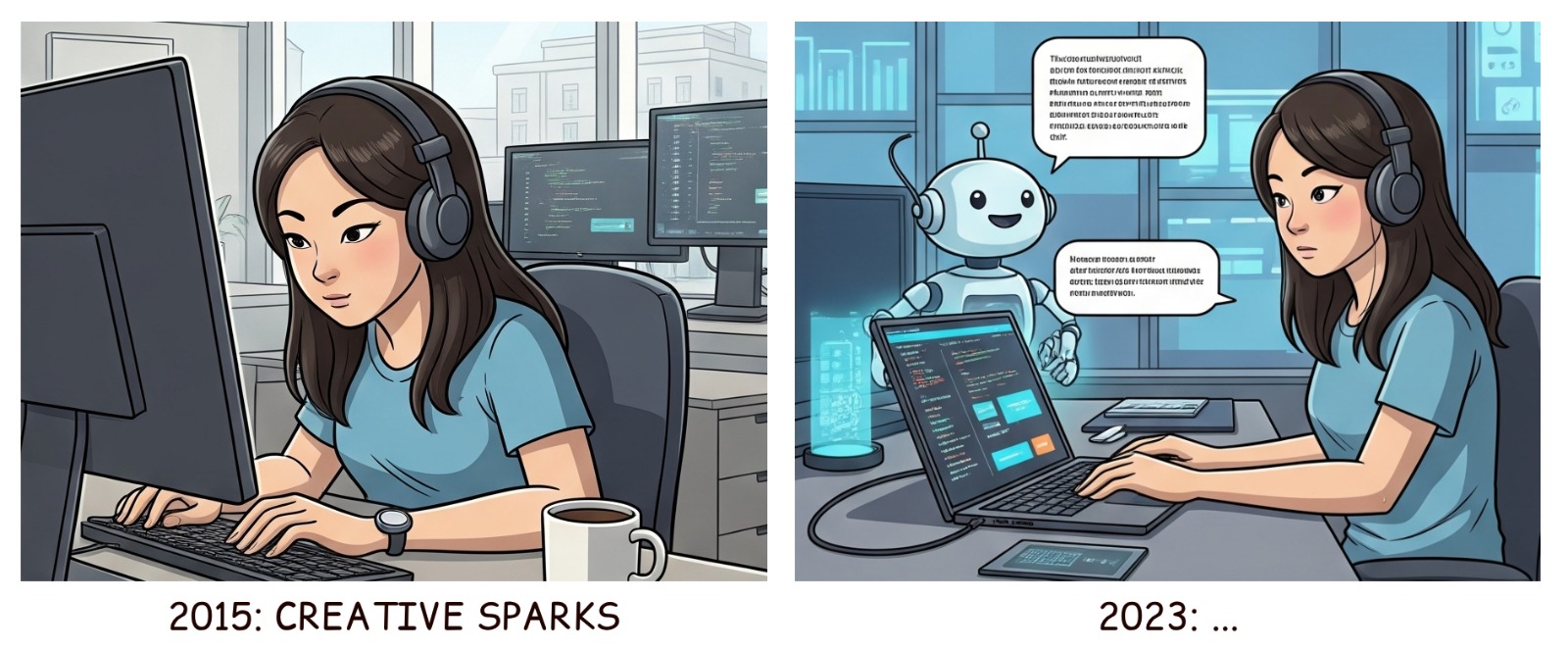
For me, AI disrupted the search → effort → reward cycle in some ways.
 |
|---|
| Ironically generated with Google Gemini |
And that’s the paradox I found myself in: by reducing the struggle and the pleasure of making, I had also reduced the surge of fulfillment that used to follow it. It wasn’t burnout, I was still working, but I felt a deeply disconnection from the intrinsic joy of problem-solving born from a process that no longer felt like it was entirely mine.
Reflecting on Reward in a Post-Effort World
The effort, the trial and error, wasn’t a barrier to the reward, but part of the reward. When AI removed that pleasure from the process, it left me asking: If I didn’t struggle to make it, why should I value the result?
So when AI reduced that effort, it also took with it the emotional weight of accomplishment.
And then, it hit even harder, when it touched my hobbies. I’ve always loved drawing and making art. But suddenly I found myself asking, “Why am I doing this if I can simply do it with AI?”
The things I loved to build felt like output rather than expression.
The Hows and the Whys
When the "how" became effortless, the "why" became everything. So I shifted my focus even more to the whys. Am I solving a real problem for users? Am I contributing to a larger goal?
Reconnecting with the purpose behind the process helped bring back a sense of meaning. Focusing on the why, on the impact, not just the outcome, helped restore meaning and a sense of genuine accomplishment. When AI handles the mechanics, the human task becomes defining intention and ensuring that what we create matters.
In this new landscape of accelerated productivity, we’re left with a powerful opportunity: to slow down, look inward, and ask the deeper questions we’ve often ignored. The real reward isn’t the polished product or results. It’s in knowing what we’re building, who it’s for, and why it matters.